


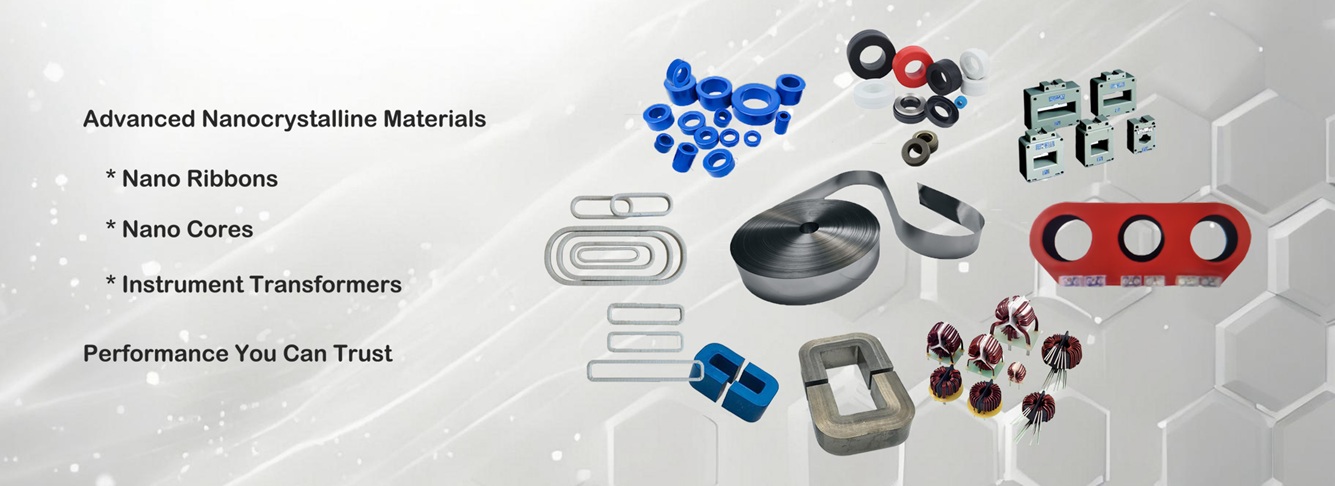

Helping You Understand Who We Are, What We Make, and the Industry We Serve.
Q: Nanocrystalline ribbons are easy to break during processing. How to avoid this?
A: It can be avoided from 3 aspects:
① Check the ribbon status before processing (avoid using oxidized ribbons with burrs on the edges);
② Control processing tension (the tension should not be too large during winding and cutting, to avoid internal stress);
③ Optimize the processing environment (keep the working environment dry to prevent the ribbon from becoming brittle due to moisture, and the processing tools should be sharp to reduce extrusion damage during cutting).
Q: Can nanocrystalline ribbons/cores from different manufacturers be mixed and used in the same set of equipment?
A: Mixed use is not recommended. There are slight differences in permeability tolerance, loss coefficient, dimensional accuracy and other aspects of materials from different manufacturers. Mixed use will lead to uneven magnetic circuit conduction of the equipment, reduce overall performance (such as reduced efficiency and increased loss), and even shorten the service life of the equipment. It is recommended to prioritize the full use of LEIMAI brand nanocrystalline ribbons and cores for the same set of equipment. Products of the same brand have more guaranteed material formulas, process standards and parameter consistency, which can maximize equipment performance. Moreover, LEIMAI products have undergone strict quality control, with better stability and compatibility.
Q: Which Soft Magnetic Material Should I Choose for My Application?
A: Selecting the right soft magnetic material hinges on understanding key properties: initial permeability (μi), saturation flux density (Bs), usable frequency range, and target applications. This page provides a detailed comparison of the most common soft magnetic materials on the market, including nanocrystalline, amorphous, permalloy, silicon steel, and ferrite.
Our experts are ready to assist you in making the perfect choice—contact us for personalized support.
|
Material |
Nanocrystalline Alloys | Amorphous Alloys | Permalloy (Ni–Fe Alloys) |
Silicon Steel | Ferrite (MnZn & NiZn) |
|
Typical Initial Permeability (μi)
|
★★★★★ Very High 60,000–120,000+ |
★★★★ 20,000–60,000 |
★★★★☆ 50,000–100,000 |
★★☆ 3,000–10,000 |
★★ MnZn: 1,500–15,000 NiZn: 100–2,000 |
|
Saturation Flux Density
|
High ~1.2 T |
High ~1.56 T |
Low ~0.8 T |
Very High ~1.9–2.1 T |
Low |
|
Frequency Range |
Low → High |
Low → Medium (≈ 50 Hz → 50–100 kHz) |
Low (≈ Hz → 10 kHz) |
Very Low (≈ 50/60 Hz) |
Medium → Very High (kHz → MHz) |
| Strengths |
1. Extremely high permeability
|
1. High saturation flux density 2. Lower cost compared with nanocrystalline 3. Good performance in medium-frequency power applications 4. Suitable for power transformers, PFC chokes, and low-frequency CTs |
1. Very high permeability 2. Extremely low coercivity 3. Excellent for low-frequency, weak-signal detection 4. Widely used in magnetic shielding and precision sensors |
1. Very high Bs, ideal for power transformers 2. Low cost and mature manufacturing 3. Good mechanical strength 4. Widely used in motors and reactors |
1. Excellent high-frequency characteristics 2. Very low core loss at high frequencies 3. Cost-effective and easy to manufacture 4. Widely used in SMPS transformers, EMI chokes, and RF components |
| Weaknesses | 1. Higher cost than ferrite 2. Difficult to machine (usually wound cores) 3. Requires annealing and protective coatings |
1. Permeability lower than nanocrystalline 2. Higher losses at high frequencies 3. Temperature stability not as strong |
1. Higher material cost 2. Low saturation flux density 3. Poor mechanical strength and sensitive to stress 4. Not suitable for high-frequency applications |
1. Much lower permeability compared with amorphous and nanocrystalline 2. High losses at medium and high frequencies 3. Not suitable for high-frequency applications |
1. Much lower Bs compared with steel or amorphous materials |
|
Typical Applications |
* Precision current transformers (CT)
|
* Distribution transformers * PFC chokes * Low-frequency CT * Medium-frequency power inductors |
* Magnetic shielding * Precision low-frequency sensors * Weak-signal detection devices |
* Power transformers * Motors * Industrial reactors * Low-frequency inductors |
* SMPS transformers * EMI suppression chokes * High-frequency inductors * RF circuits |
Q: What are the advantages of nanocrystalline ribbons compared to traditional silicon steel or permalloy?
A: Nanocrystalline ribbons offer high permeability, low core loss, high saturation flux density, and excellent temperature stability.
Compared with silicon steel, they perform better in high-frequency applications;
Compared with permalloy, they offer a better cost-performance ratio, making them ideal for common-mode chokes, transformers, inverters, and other power electronics.
Q: What are your standard thickness and width options? Can they be customized?
A: The standard thickness of nanocrystalline ribbons is typically 10~32 μm, and the width ranges from 3~60 mm.
We can also provide customized widths, special treatments, and precision slitting based on your specific requirements.
